On 30 October 2026, four UK regulators said it plainly. In a joint statement from the Digital Regulation Cooperation Forum, the FCA, the CMA, the ICO and Ofcom wrote:
“An AI agent’s autonomy does not diminish the responsibility of organisations that deploy it to comply with applicable law and relevant regulation.”
They said existing frameworks already apply, naming “financial services, payments and cyber security requirements” among them, and asked firms deploying agents to think carefully about “who is accountable for the agent’s decisions and how to obtain redress when something goes wrong.” Where they suspect a breach, “we will not hesitate to use our powers.”
The statement is aimed at AI agents that act for consumers. We expect the same line to be drawn for the agents firms use in their own operations; the regulators’ reasoning does not depend on who the agent works for. And the principle is not new. Across private markets, firms have always answered for the work done in their name, whoever or whatever prepared it: the administrator for the books, the GP for its LP reporting, the AIFM or ManCo for the NAV it signs off, the LP or fund of funds for the figures in its own investment committee pack, the development bank for the portfolio data it reports to its shareholders. Agents do not change that. They make it urgent to be clear about where they sit.
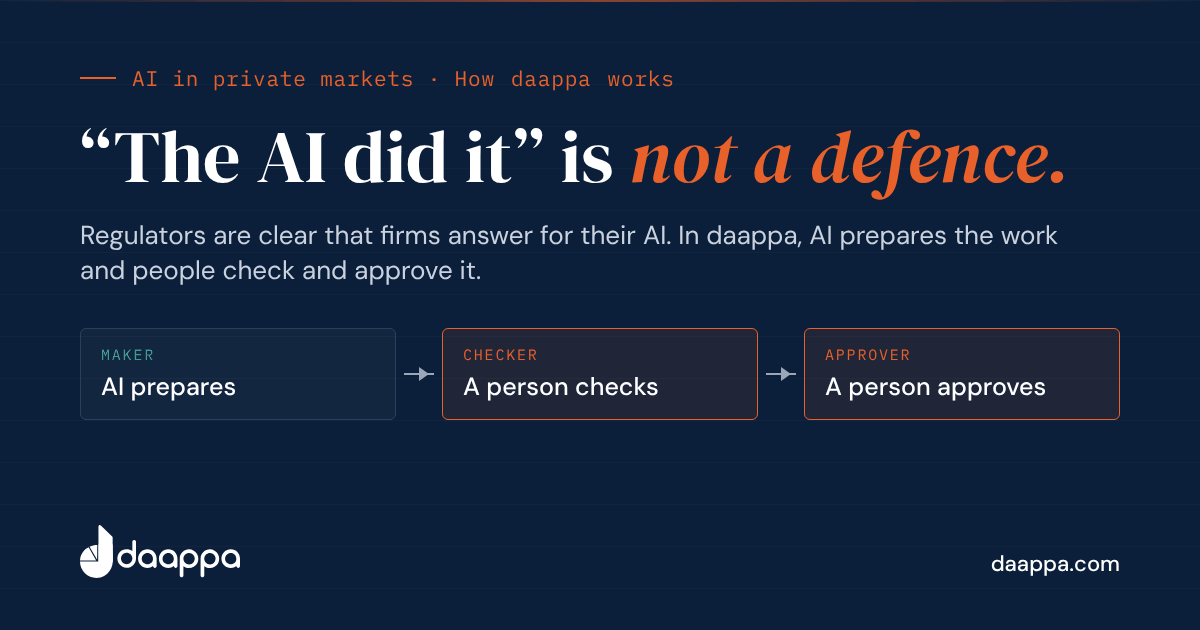
Our answer: AI is the maker. People check and approve.
Every act that moves money, changes a fund’s books or puts a figure in front of investors runs through three steps. Someone prepares it, someone else checks it, and an authorised person approves it. The separation exists so that no single party can both produce a figure and confirm it.
In daappa, AI can take the first step. The work it prepares depends on who you are:
- Fund administrators: reconciliations, the entries behind a capital call, month-end close.
- GPs: portfolio company figures read from monthly and quarterly reports, ready for LP reporting.
- LPs and funds of funds: values read from GP quarterly reports and capital account statements.
- AIFMs and ManCos: the NAV movements and exceptions in an administrator’s pack that need explaining.
- Development banks: investee reports read into one consistent data set across the portfolio.
These are high-volume tasks with clear inputs. That is where AI saves time. The second and third steps carry the judgement and the accountability. They stay with people.
Why the regulators’ line points this way
Responsibility stays with the firm. For AIFMs, AIFMD already says the same about delegation: handing a task to someone else does not reduce the manager’s liability to the fund and its investors (Article 20(3)). In May 2024 ESMA made the point about AI directly: firms’ decisions “remain the responsibility of management bodies, irrespective of whether those decisions are taken by people or AI-based tools”.
In the UK, a named person answers. The FCA regulates AI through its existing rules. In its April 2024 AI Update it said that for firms under the enhanced Senior Managers and Certification Regime, “any use of AI in relation to an activity, business area, or management function of a firm would fall within the scope of a SMF manager’s responsibilities.” If a named person answers for the outcome, a person should check it before it is committed.
Luxembourg is looking at oversight in practice. The CSSF and the Banque centrale du Luxembourg reviewed human oversight, alongside explainability and auditability, in their second thematic review of AI in the financial sector (May 2025).
Auditors need to see who decided. “Approved by the system” answers nothing. A record that names the preparer, the checker and the approver, with a time for each, answers the auditor’s first question before it is asked.
How it works in daappa
- Proposals, not postings. Whatever AI prepares arrives as a proposal. Nothing reaches the ledger until a person checks it and an authorised person approves it, through the same approval matrix your team uses. In daappa Studio+, Extractor AI sends uncertain values to a reviewer with the figure boxed on the source document, and nothing is committed to DataHub until a second person approves it.
- Oversight without changing your administrator. NAV Oversight puts a person’s review and sign-off on every exception in the NAV pack your administrator already sends.
- The record shows who did what. Every step records who acted and when, so AI-prepared work is always distinguishable from work a person prepared.
- The engine does the arithmetic. Where AI suggests a fix, daappa’s own calculation engine produces the entries, so figures come from the system of record and not from model output.
- You decide where AI runs. AI access is switched on or off by area, and every AI request against your data is logged.
What comes next
Coming soon: MCP, the open protocol AI assistants use to connect to business systems, so your team can query the system of record without exporting a file. We already use it internally.
Next year: agents that act as makers across reconciliations, month-end close, document review, statement review and valuation checks. They will propose work into the approval queue like any other preparer. The checker and the approver will stay people.